
Jellyfish in Almería today: reports and swimming guide
Check recent observations on Almería beaches, learn to recognise Alboran Sea species and respond safely to a sting.
Recent reports
Last 12 hChecking reports…
No reports does not mean absence. Beach signs and lifeguards always prevail.
Earlier observations
12–24 hWhat to do after a jellyfish sting
General guidance from the Spanish Ministry of Health and ICM-CSIC when the species is unknown.
- Leave the waterand alert a lifeguard if present.
- Rinse without rubbingwith seawater or saline solution.
- Remove remainswith tweezers or the edges of two cards; never with bare hands.
- Apply indirect coldfor up to 20 minutes, with ice inside a bag or cloth.
- Do not improvise remediesDo not use fresh water, alcohol, ammonia, urine or vinegar as general treatment.
- Monitor symptomsand seek medical care if pain is severe or worsens.
Call 112 for breathing difficulty, severe dizziness, vomiting, widespread cramps, altered consciousness or an extensive reaction. Take extra care with children, older adults, pregnant people and anyone with allergies or heart conditions.
Vinegar depends on the species: it can help in some cases and worsen discharge in others. If the species is unknown, use seawater or saline and follow lifeguard advice.
Almería jellyfish catalogue
The order prioritises the species most useful to identify in Almería. The label shows how strongly they can sting. Do not touch them or remove them from the water or shore: move away and alert a lifeguard.
How to read the catalogue and when to alert someone
Labels follow the Observadores del Mar toxic-capacity scale; they do not show how common a species is. Photos are a guide, not a confirmed identification. If no lifeguard is present and you see a concentration or a Portuguese man o war in the swimming area, inform local police or civil protection. Use 112 only for immediate danger or severe symptoms. If unsure, report it.
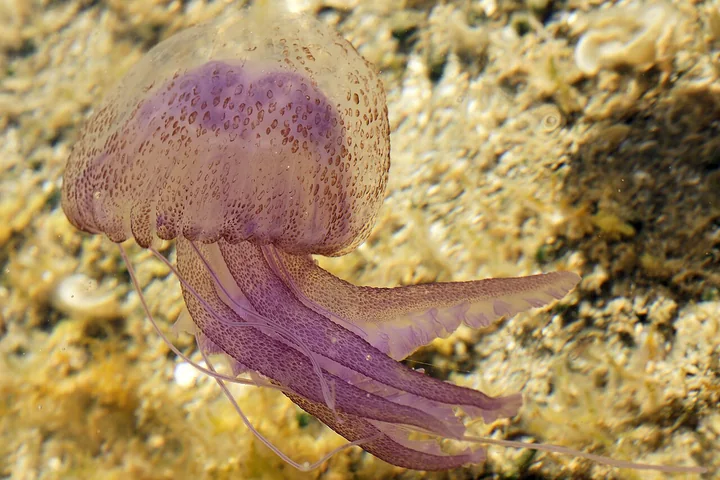 Highly stingingMauve stingerPelagia noctilucaYes: report it
How to recognise it: Small or medium, pink or violet, with dots and very long, thin tentacles.
Sting and precautions: It can cause itching, intense pain, swelling and redness; some skin lesions may persist. Nausea, vomiting, cramps or breathing difficulty are uncommon but need urgent medical attention. Detached or stranded tentacles can still sting. If several are present in the swimming area, move away and alert a lifeguard.
Photo: Hans Hillewaert · CC BY-SA 4.0
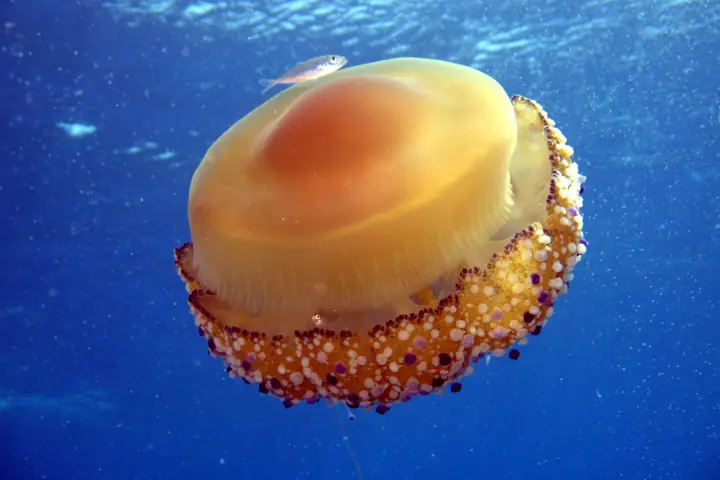 Mildly stingingFried egg jellyfishCotylorhiza tuberculataYes: report it
How to recognise it: Yellow or orange dome like an egg yolk, surrounded by a pale disc; short arms with violet tips.
Sting and precautions: Its stinging capacity is low and usually causes very little or almost no effect, although a skin reaction is possible. Do not touch it; do report it to inform other swimmers.
Photo: Sarah Faulwetter · CC BY 4.0
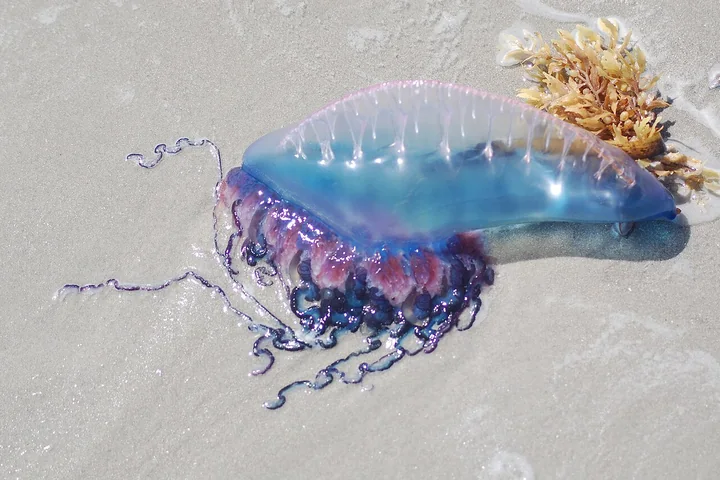 Highly stingingPortuguese man o warPhysalia physalisAlert a lifeguard and report it
How to recognise it: Blue or violet float with a sail-like crest; its tentacles can be many metres long.
Sting and precautions: Contact can cause intense pain and, in some cases, a systemic reaction. Do not touch it or try to remove it from the water or shore; move away and alert a lifeguard. Call 112 if severe symptoms appear. It is documented in Almería but usually occurs in isolated episodes.
Photo: Brett Ortler · CC BY 4.0
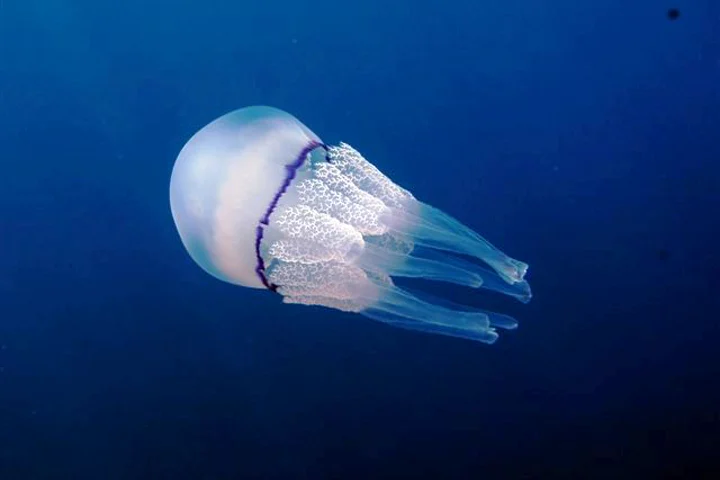 StingingBarrel jellyfishRhizostoma pulmoYes: report it
How to recognise it: Large, whitish or blue, with a blue-violet rim and thick oral arms; no long marginal tentacles.
Sting and precautions: It can cause burning or pain and intense irritation, although reactions are usually limited to the skin. Its mucus also contains stinging cells, so a reaction is possible without directly touching the jellyfish.
Photo: Dario Romeo · CC BY 3.0
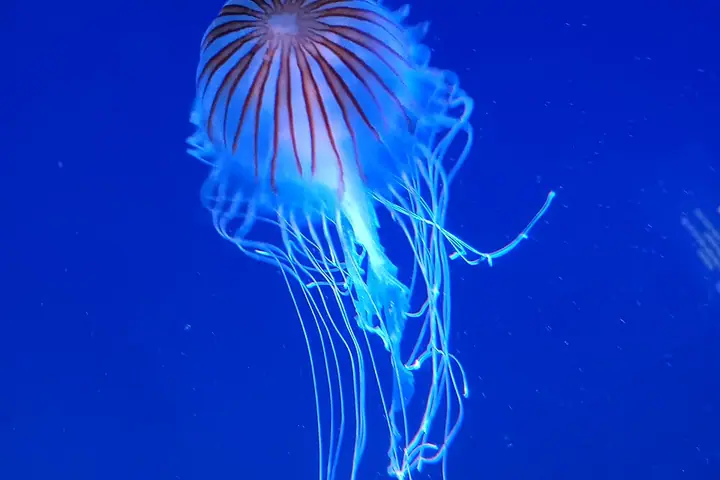 Highly stingingCompass jellyfishChrysaora hysoscellaYes: report it
How to recognise it: Pale bell with 16 brown compass-like bands and long tentacles.
Sting and precautions: It usually causes strong pain, burning and itching; redness or swelling can continue for up to 48 hours. Severe cases are uncommon, but do not touch it even when stranded. If one appears in the swimming area, move away and alert a lifeguard.
Photo: Aminhadia72 · CC BY 4.0
Other less common or localised species
These are secondary references because their presence may be scarce, occasional, hard to observe or localised. That does not mean they are impossible in Almería.
- Aurelia spp. · mildly stinging; transparent bell with four visible rings.
- Aequorea forskalea · mildly stinging; transparent with many radial canals.
- Rhizostoma luteum · stinging; very large, whitish and with long dark arms.
- Carybdea marsupialis · highly stinging; small, box-shaped, transparent and hard to see.
- Cassiopea andromeda · mildly stinging; non-native species confirmed locally in Aguadulce harbour.
Lookalikes not to report when you are certain
If identification is not clear, do not take a risk: move away, alert a lifeguard and use the report.
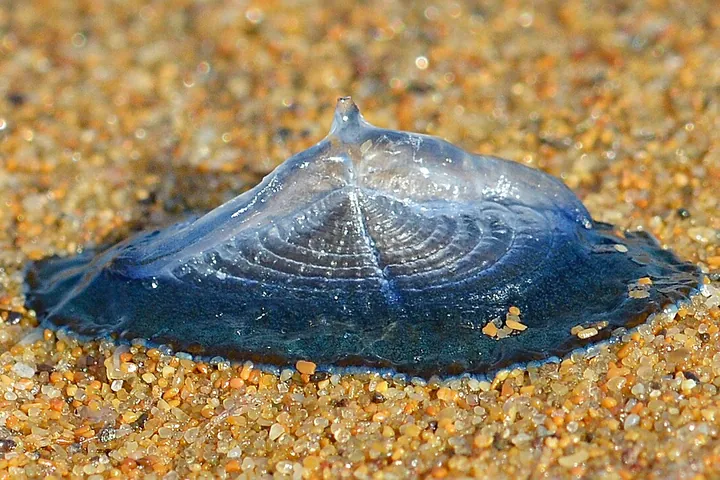 Mildly stingingBy-the-wind sailorVelella velellaDo not report it if you are certain
How to recognise it: Blue oval disc with a small transparent sail; thousands may wash ashore.
Sting and precautions: Its stinging capacity is low and usually causes very little or almost no effect, although a skin reaction is possible. Do not handle it and avoid touching your eyes.
Photo: Ryan Hodnett · CC BY-SA 4.0
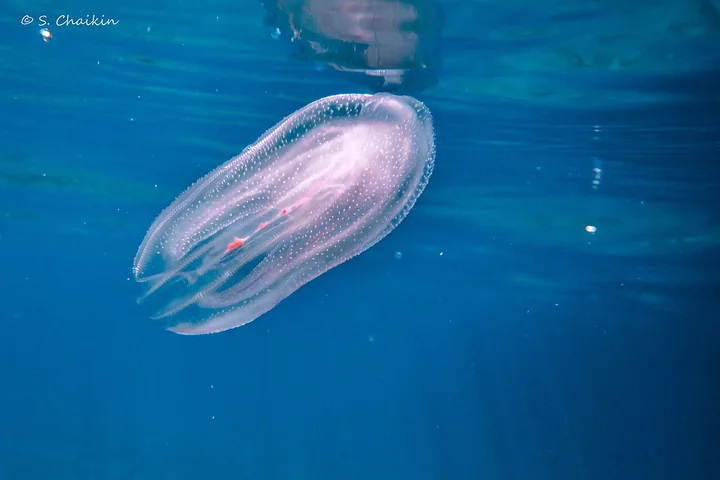 Non-stingingComb jelly or sea walnutMnemiopsis leidyiDo not report it if you are certain
How to recognise it: Transparent oval body, without a bell or long tentacles; its rows may reflect rainbow colours.
Sting and precautions: It has no stinging cells and is harmless to human health. It is an invasive species with ecological impact, but it does not create a swimming alert.
Photo: shahar chaikin · CC BY 4.0
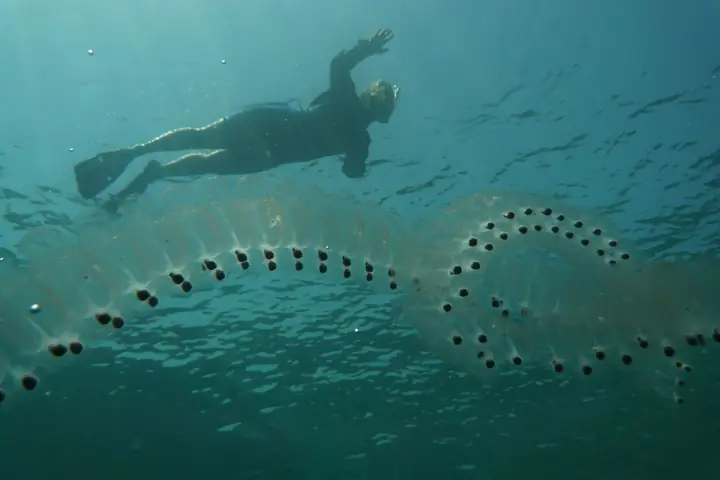 Non-stingingSalpsSalpidaeDo not report them if you are certain
How to recognise it: Transparent barrel-shaped bodies, alone or in chains; the digestive system appears as a brown dot.
Sting and precautions: They have no stinging cells and are harmless to human health. They are pelagic tunicates, not jellyfish; do not report them when you can confidently recognise their chained bodies.
Photo: Lars Plougmann · CC BY-SA 2.0
What each report means
Report stinging jellyfish, fried egg jellyfish and Portuguese man o war. Do not report Velella, comb jellies or salps only when identification is certain. Quantity sets the report intensity. A selected species is shown as an unverified user identification.
Jellyfish reports and guide for Almería beaches